Songs and Emotional Expression
My Tender MatadorSongs and Emotional Expression are not simply a soundtrack to the Queen of the Corner’s life: music gives form to feelings she struggles to state, from her imagined romance with Carlos to a hesitant recognition of the suffering around her. Old songs make her house a refuge and her longing almost theatrical, while news broadcasts and protest voices carry public fear into that private world. Over time, the distinction between a personal heartbreak and a political wound becomes harder to maintain.
Music as Refuge and Public Presence
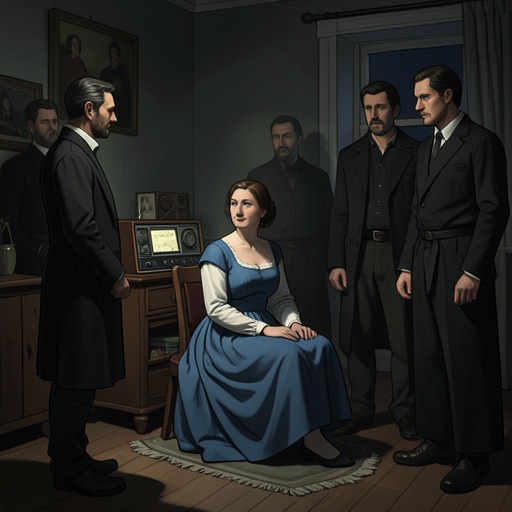
In the spring of 1986, the Queen makes her dilapidated corner house her own by filling it with song. As she hangs laundry from the rooftop, she sings “My tender matador,” turning an expression of fear that her beloved’s smile might disappear into a private refrain. Her repertoire also includes Lucho Gatica songs and “Bésame Mucho”; played loudly, the music wakes the neighborhood and becomes its informal morning alarm. What begins as self-expression thus reaches beyond her rooms, giving an often weary block a shared daily rhythm.
The house is also where the Queen embroiders sheets and oversized tablecloths for wealthy older women. While working, she prefers golden-oldies programs to Radio Cooperativa, whose reports of protests and urgent communiqués frighten her. The contrast is not simply between entertainment and politics: music lets her retreat from bad news, but the broadcast remains audible in the same wider world that her songs cannot shut out. Her refuge is a chosen space, not an escape from the conditions outside it.
Songs also supply a language for the Queen’s early intimacy with Carlos. During long vigils while men meet upstairs, she stays awake beside him, hoping for conversation and recalling her past in fragments. After she tells him that her father’s violence and her childhood left deep fear and pain, Carlos asks her to continue another day. The brief verse that follows makes trust a condition of love and distinguishes affection from what she feels she receives from him. The song gives shape to a confession that the encounter itself leaves unfinished.
Longing, Performance, and Disappointment
When the Queen and Carlos share a picnic away from the city, she tries to hold the moment in memory as though it were a staged scene. On their return, however, Carlos drives away without the goodbye she expects. She puts the wildflowers in water and tries to keep from crying, turning instead to boleros about temporary love, separation, and giving oneself to someone who does not return that devotion. Their familiar lyrics help narrate the rejection, but they cannot make its cause clear to her. She is left with the sharper knowledge that Carlos has treated her as someone to be left behind.
The song “My tender matador” returns on Carlos’s birthday, after the children’s party the Queen has organized for him. As the party ends and the house falls quiet, she plays the record and offers him pisco and soda. Carlos tells her it is the best birthday he has had and says he wants to toast to having met her. The exchange gives her a moment of apparent reciprocity, but it does not resolve the disparity between her romantic hopes and his guardedness. Music makes the tenderness of the occasion legible while leaving its limits intact.
The Queen privately gives that intimacy a further meaning that Carlos cannot share: while he is drunk and asleep, she understands her attentiveness to him as an act of love and imagines it as a song addressed directly to his heart. She also recognizes that he will never know what the gesture means to her. A later verse about longing to hold a beloved and whisper words of love underscores the gap between the feeling she voices through song and the mutual relationship she wants. Music can accompany an intimate gesture, but it cannot make that gesture reciprocated or understood.
From Radio News to Public Witness
Political feeling enters the Queen’s life first through the radio and through the people whose suffering she hears described. During a drive with Carlos, patriotic songs are repeatedly interrupted by Radio Cooperativa’s report that the Manuel Rodríguez Patriotic Front claimed responsibility for the blackout across the Santiago metropolitan area. The station, which once frightened her, becomes a reassuring presence when bombs interrupt the electricity and she has to use batteries. Its familiar voice also recalls Carlos’s insistence on following the news. As she listens, the reports of bereaved relatives begin to move her in their own right: she thinks of women searching for missing loved ones and carrying photographs while asking for news.
That movement from listening to speaking becomes visible on a bus ride across Santiago. When another passenger dismisses young people who protest and strike, the Queen answers that the country is not as the government presents it: soldiers are everywhere, and explosions and shootings prevent people from sleeping. Students applaud her. She is surprised and a little afraid of having spoken publicly, but imagines Carlos approving of her courage. Her response is shaped by political conviction as well as by the wish to be seen by him; the scene holds those motives together without making them identical.
Later, after a police officer strikes and humiliates her for reaching toward a demonstration leaflet, the Queen’s thoughts turn toward the resistance Carlos is connected with. At the Plaza de Armas she encounters women holding photographs of arrested and disappeared relatives and takes up a placard bearing the photograph of a disappeared person. She joins their demand to know where their loved ones are, and among them she is not embarrassed by her high-pitched voice. When police sirens arrive to disperse the gathering, she runs and carries the photograph away folded in her pocket. The movement from radio reports to taking part in a public act of remembrance marks a change: the suffering that once reached her through broadcasts has become a reason to join others’ voices.
Separation and the Song’s Afterlife
The Queen’s departure from Santiago turns the separation from Carlos into a loss of place as well as a loss of hope. After being told that the secret police are expected to search her home, she resists leaving the house that has been her refuge. The people arranging her escape insist that it is necessary for her safety and theirs, and she makes seeing Carlos again her condition for agreeing to go. As a car carries her away, the city recalls earlier journeys with him; now those memories sharpen the sense that her love story is being torn apart. Her face is reflected in the window as she cries, a response she cannot control.
Across these episodes, song does not solve the Queen’s loneliness or reconcile private love with political danger. Instead, it gives changing form to what she experiences: boleros first furnish a vocabulary for an imagined romance and its disappointments, while radio news brings distant suffering close enough to move her toward public solidarity. The refrain of “My tender matador” links longing to the fear of loss, but its recurrence cannot preserve the relationship. By the time the Queen leaves the city, music remains a way of carrying feeling through separation, not a promise that separation can be undone.